Propaganda American Style

The Boston Massacre is one those events… known by many, understood by few. It stands part of the American mythology, our Revolutionary martyrs gunned down by the wicked standing army of our British oppressors. One great patriot, Paul Revere, helped perpetuate the myths surrounding the event by producing the most recognizable image of March 5, 1770,

Revere’s propaganda

Another great patriot, John Adams… had a strikingly different view of the same event. Adams, who defended the soldiers at their murder trial, had this to say;

“Facts are stubborn things; and whatever may be our wishes, our inclinations, or the dictates of our passion, they cannot alter the state of facts and evidence….a motley rabble of saucy boys, negroes, and molattoes, Irish teagues and outlandish jack tarrs , they had the legal right to fight back, and so were innocent. If they were provoked but not endangered, he argued, they were at most guilty of manslaughter.”

Adams believed in law and order… despite inflamed passions of the day. He realized that there was a proper path to justice, rioting in the street was not the American way.

Leave a comment

Filed under Ephemera

Weekly History News Roundup

JFK was unpopular in Canada… new book examines Kennedy legacy from Canadian perspective


Confederate flag rally in Gettysburg nearly turns violentNPS Rangers forced to separate counter protests


Nixon library completes $15 million renovation… new exhibit will highlight Nixon’s 1972 trip to China


Japanese internment in Alaska rediscovered… archaeologists pinpoint camp location near Juneau


New Civil War film details escape from Confederate prison… “Union Bound” is based on the diary of Sgt. Joseph Hoover


Heritage or hate?

Heritage or hate?

1 Comment

Filed under News

Tarawa (1)

The Battle of Tarawa was one of the more terrible American experiences in the Pacific theatre of World War Two. It was one that would shape the future of amphibious assaults. In late 1943, the United States launched attacks in the central Pacific. These were meant to speed up victory in the war by drawing […]

https://pacificparatrooper.wordpress.com/2016/03/03/tarawa-1/

1 Comment

Filed under Uncategorized

“Royal” Green Among Wilderness Brown

While I love hiking battlefields as a way to better understand the history that unfolded there, I also love being out in nature. There’s so much cool stuff to see—something my father opened my eyes to as a young boy and something I’ve enjoyed ever since. It’s always with a sense of awe that I […]

http://emergingcivilwar.com/2016/03/04/152925/

Leave a comment

Filed under Uncategorized

Essential Civil War Reader

Books that need to be on every Civil War Buff’s shelf….

Probably would happen

Probably would happen

  • Battle Cry of Freedom, by James McPherson. Winner of the Pulitzer Prize, this is the best one volume account of the War told by its greatest storyteller. It traces the conflict from Free Soil to the assassination of Lincoln in an authoritative voice that has yet to be rivaled.
  • To the Gates of Richmond, by Stephen Sears. Only Sears could encapsulate the quagmire of McClellan’s Peninsular campaign into a single, eminently readable volume. The book brilliantly weaves multiple story-lines from common soldiers all the way to the Commander-in-Chief- Sears proves there is no greater authority on the McClellan/Lincoln feud.
  • No Better Place to Die, by Peter Cozzens. The rare book that definitively recounts the battle, while bringing humanity to the brave men who fought it. Cozzens’ tactical knowledge is matched only by his exhaustive research into hundreds of primary sources. No finer battle study has been produced- Stones River is no longer a forgotten battle.
  • Gettysburg; The Second Day, By Harry Pfanz. No man knew Gettysburg better, Dr. Pfanz’s book is the definitive study of July 2, 1863. By focusing on the pivotal day of the battle, Pfanz brings the sacrifices of the men into clearer perspective. Far too much ink has been spilled on Pickett’s charge, Pfanz shows us the battle was truly won the day before.
  • The Iron Brigade, By Alan Nolan. More than a unit history, Nolan’s book is military history at its finest. By tracing the unit through primary sources, from its Commanders to the private soldiers, Nolan’s book provides a rich and exciting narrative. The detailed description of battles with the legendary Stonewall Brigade set the book apart. This book is the standard all subsequent unit histories are measured.
  • Joshua Chamberlain: A Hero’s Life and Legacy, by John Pullen. The perfect companion to Pullen’s regimental history of the 20th Maine, this biography of its legendary leader stands the test of time. Pullen separates myth from fact in recounting Chamberlain’s heroic military service. Like any great biographer, Pullen finds the man in the midst of hyperbole and legend.
Soul of the Lion

Soul of the Lion

Leave a comment

Filed under Uncategorized

Political Opportunist in Uniform

James A. Garfield wanted to advance his political career… a brief stint commanding Ohio volunteers followed by an undistinguished term as a Congressman stalled the upstart’s career.

The Mentor

The Mentor

Concluding military service essential to future political ascension…. Garfield used favors of his mentor (and distant cousin) Salmon P. Chase to reenter military service, this time as a General. The Lincoln administration needed an appropriate duty station for the young Ohioan’s “talents.”

Self-serving service

Self-serving service

Eccentric, brilliant, but irascible… William S. Rosecrans was on Secretary of War Edwin Stanton’s last nerve. Stubborn to a fault, Rosecrans refused to bow to the Administration’s unreasonable timetables. The popular Rosecrans needed to go, but Stanton needed just cause. The cagey Garfield seemed the perfect plant- Rosecrans needed a new Chief-of-Staff- Stanton needed an ally close to the troublesome Commander. The drama was set….

Unwitting victim

Unwitting victim


Leave a comment

Filed under Uncategorized

Soul of a Lion

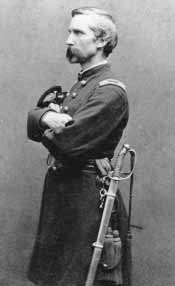
Lt. Col. Chamberlain

Lt. Col. Chamberlain

Joshua Lawrence Chamberlain answered his… nation’s call with extraordinary valor. His standing in the social circles of Maine could have won him a Colonel’s commission, but Chamberlain deferred- he wanted to learn the craft of soldiering before commanding troops. His training was hands-on and brutal. The 20th Maine’s baptism of fire was on the killing fields of Fredericksburg- Chamberlain and the men spent a miserable night on the battlefield between the lines;

“…the writhing concord broken by cries for help, some begging for a drop of water, some calling on God for pity; and some on friendly hands to finish what the enemy had so horribly begun; some with delirious, dreamy voices murmuring loved names, as if the dearest were bending over them; and underneath, all the time, the deep bass note from closed lips too hopeless, or too heroic to articulate their agony…It seemed best to bestow myself between two dead men among the many left there by earlier assaults, and to draw another crosswise for a pillow out of the trampled, blood-soaked sod, pulling the flap of his coat over my face to fend off the chilling winds, and still more chilling, the deep, many voiced moan that overspread the field.”
Bayonets!

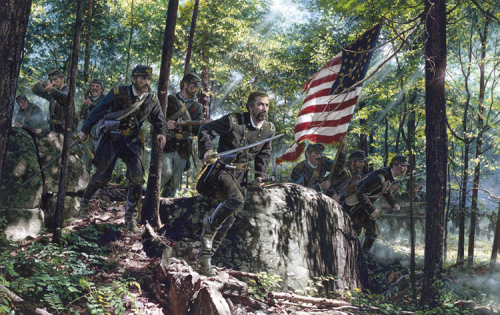
Bayonets!

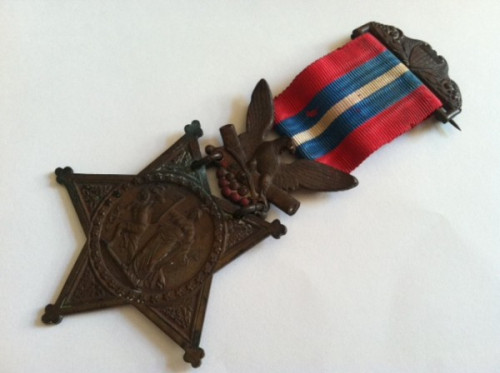
Commanding the regiment at Gettysburg… the following Summer, Chamberlain led his men to glory on the slopes of Little Round Top. The bayonet charge he ordered helped save the Union left- it also earned him the Medal of Honor;

Citation:

The President of the United States of America, in the name of Congress, takes pleasure in presenting the Medal of Honor to Colonel Joshua Lawrence Chamberlain, United States Army, for extraordinary heroism on 2 July 1863, while serving with 20th Maine Infantry, in action at Gettysburg, Pennsylvania, for daring heroism and great tenacity in holding his position on the Little Round Top against repeated assaults, and carrying the advance position on the Great Round Top.
Daring heroism and great tenacity

Daring heroism and great tenacity

Gallantly leading his brigade in action… near Petersburg, Virginia on June 18, 1864, Chamberlain was struck down by a ball, leaving a wound surgeons believed mortal. Lt. Gen. US Grant finally granted Chamberlain the long overdue promotion to Brigadier General;

“Col. JL Chamberlain was wounded on the 18th- he was gallantly leading his brigade at the time, as he had been in habit of doing in all the engagements… on this occasion, however, I promoted him on the spot…”


Leave a comment

Filed under Ephemera, News